



AI Agents and Automation: Transforming the Future of Work
Introduction
Artificial Intelligence (AI) is transforming the way businesses operate, helping organizations automate tasks, improve productivity, and make better decisions. One of the most important developments in AI is the rise of AI agents and intelligent automation.
AI agents are intelligent systems that can understand goals, analyze information, make decisions, and perform tasks with minimal human intervention. When combined with automation tools, AI agents can help businesses streamline workflows, reduce repetitive work, and improve operational efficiency.
Today, AI agents are being used in customer support, software development, marketing, cloud operations, data analysis, and many other industries.
What Are AI Agents?
AI agents are software systems designed to perceive information, reason about a task, and take actions to achieve a specific goal.
Unlike traditional automation, which follows predefined rules, AI agents can use AI models to interpret instructions, handle certain variations, and choose appropriate next steps.
For example, a traditional automation workflow might send the same confirmation email whenever a form is submitted. An AI agent could analyze the form, classify the request, draft a personalized response, and route the request to the appropriate department.
The level of autonomy depends on the agent's design, tools, permissions, and instructions.
Key Features of AI Agents
Reasoning: Analyze information and determine suitable next steps.
Decision-making: Select actions based on the task and available information.
Tool integration: Interact with APIs, databases, applications, and automation platforms.
Task execution: Perform actions to achieve a defined objective.
Context awareness: Use relevant information from the current task or connected data sources.
Adaptability: Handle some unexpected inputs without requiring a completely new workflow.
What Is Automation?
Automation is the use of technology to perform tasks with reduced manual effort. It helps organizations complete repetitive activities faster, more consistently, and with fewer human errors.
Common automation examples include sending emails, generating reports, updating spreadsheets, processing customer information, and triggering notifications.
Traditional automation often relies on predefined rules and conditions. AI-powered automation adds capabilities such as language understanding, content generation, classification, and intelligent decision support.
AI Agents vs. Traditional Automation
Traditional automation and AI agents are related, but they serve different purposes.
| Feature | Traditional Automation | AI Agents |
|---|---|---|
| Working method | Predefined rules | AI-driven reasoning and actions |
| Decision-making | Fixed conditions | Context-dependent decisions |
| Input handling | Often structured | Can handle unstructured inputs |
| Flexibility | Limited to programmed workflows | Can adapt within defined boundaries |
| Best suited for | Repetitive, predictable tasks | Tasks requiring interpretation |
| Human involvement | Setup and exception handling | Supervision and approval may be needed |
The best solution often combines both approaches. Traditional automation provides reliable workflow execution, while AI agents help interpret information and select appropriate actions.
How AI Agents and Automation Work Together
AI agents and automation can be combined to create intelligent workflows.
A typical workflow includes the following steps:
Receive input: A user submits a request through a form, email, website, or chat application.
Analyze information: The AI agent understands the request and identifies the user's intention.
Make a decision: The agent determines the next appropriate action.
Execute the task: An automation platform runs the required workflow or calls connected tools.
Verify the result: The system checks whether the action succeeded.
Notify the user: The workflow sends a response or requests human assistance when necessary.
This approach can reduce manual effort while keeping important business processes organized.
Popular Tools for AI Agents and Automation
Several platforms help developers and businesses create AI-powered workflows.
1. n8n
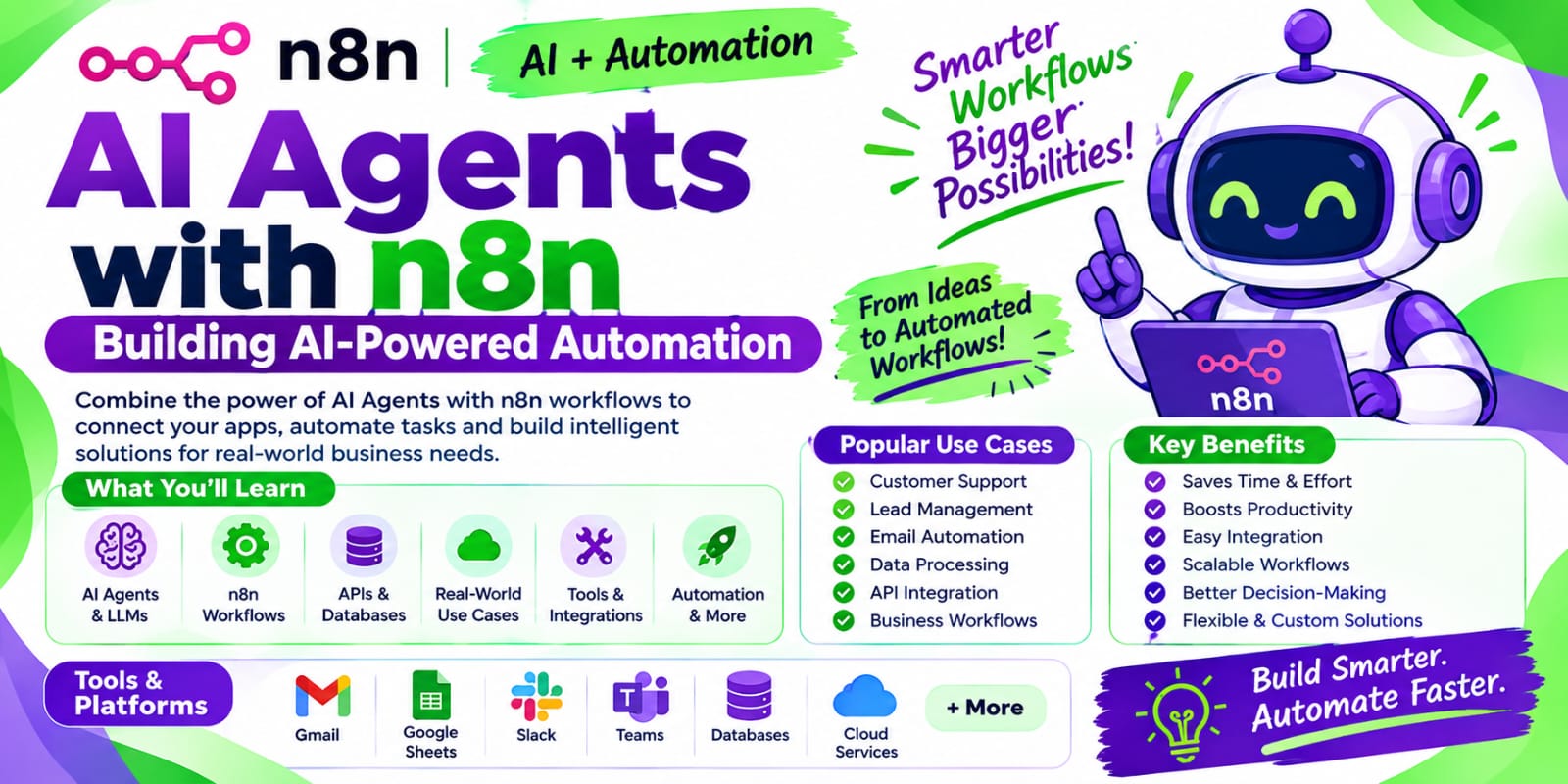
n8n is a workflow automation platform that connects applications, APIs, and AI services. It supports visual workflow building and can be used to create AI-powered automations.
With n8n, users can connect language models, process incoming messages, retrieve information, update records, and trigger workflows based on events.
Example: An AI agent receives a customer enquiry, identifies the topic, prepares a response, and routes the enquiry to the correct team.
2. OpenAI Models
OpenAI models can help AI applications understand instructions, generate content, summarize information, and support reasoning tasks.
When connected to suitable tools and workflows, these models can serve as the intelligence layer of an AI agent.
3. Zapier
Zapier connects different applications and automates tasks between them. It can be used to build workflows that trigger actions when specific events occur, with AI capabilities available in supported features.
4. LangChain
LangChain provides frameworks and tools for building applications powered by language models, including applications that connect models to tools, external data, and other services.
5. APIs and Webhooks
APIs and webhooks allow applications to exchange information and trigger actions. They are essential building blocks for connecting AI agents with business systems and automation workflows.
Real-World Applications of AI Agents and Automation
1. Customer Support Automation
AI agents can classify customer enquiries, answer common questions using approved information, and route complex issues to human support teams.
2. Marketing Automation
AI agents can assist with generating content ideas, summarizing campaign results, categorizing leads, and preparing personalized communications.
3. IT and DevOps Automation
AI agents can help analyze logs, summarize monitoring alerts, investigate common incidents, and suggest troubleshooting steps.
For production systems, actions such as restarting services or changing infrastructure should follow access controls, testing, and approval policies.
4. Sales Automation
AI-powered workflows can organize incoming leads, summarize customer interactions, update CRM records, and prepare follow-up messages.
5. Data Processing
AI agents can extract relevant information from documents, classify records, summarize reports, and send structured results to connected applications.
6. HR and Recruitment
AI-assisted workflows can organize applications, summarize candidate-provided information, schedule interviews, and answer frequently asked questions. Sensitive hiring decisions should remain subject to appropriate human review.
Example: Building an AI Agent Automation Workflow Using n8n
Consider a company that receives many enquiries through a website contact form.
The company wants to classify each enquiry and notify the correct department automatically.
The workflow can be designed as follows:
Step 1: Trigger
A new enquiry arrives through a form or webhook.
Step 2: AI Analysis
An AI model analyzes the message and categorizes it as a sales enquiry, technical support request, billing question, or general enquiry.
Step 3: Workflow Decision
An n8n conditional node checks the category returned by the AI model.
Step 4: Automated Action
The workflow saves the enquiry in a database or CRM and sends a notification to the appropriate team.
Step 5: Response Generation
The AI model prepares a suitable acknowledgement based on approved company information.
Step 6: Human Review
If the enquiry is sensitive, unclear, or requires a commitment, the workflow sends it to a human for approval before responding.
This example demonstrates how AI reasoning and rule-based automation can work together in a practical business environment.
Benefits of AI Agents and Automation
Increased Productivity
AI agents can assist with time-consuming tasks, allowing employees to focus on work that requires creativity, communication, and judgment.
Reduced Repetitive Work
Automated workflows can handle routine activities such as classifying enquiries, preparing summaries, and updating records.
Faster Response Times
AI-powered systems can process incoming requests and trigger appropriate actions without waiting for every step to be completed manually.
Improved Consistency
Standardized workflows help businesses follow the same process for routine tasks.
Better Scalability
Organizations can automate more workflows as their needs grow, provided their systems have sufficient capacity and appropriate monitoring.
Improved Access to Information
AI agents can summarize information from approved sources and help users find relevant details more quickly.
Challenges and Limitations
Although AI agents offer significant benefits, they also introduce challenges.
Incorrect outputs: AI models can produce inaccurate or misleading information.
Data privacy: Workflows must protect confidential and personal information.
Security risks: Connected tools and APIs must use appropriate permissions.
Integration complexity: Connecting different applications can require technical knowledge.
Operational costs: Model usage, infrastructure, and maintenance may increase costs.
Unpredictable behavior: AI agents may interpret ambiguous instructions incorrectly.
To address these challenges, organizations should use clear instructions, limited permissions, validation rules, monitoring, and human approval for high-impact actions.
Best Practices for Implementing AI Agent Automation
Start with a simple, repetitive business task.
Define a clear goal and measurable success criteria.
Select suitable AI models and automation tools.
Connect only the applications and data the agent needs.
Validate AI-generated outputs before important actions.
Require approval for payments, deletions, external commitments, or other sensitive operations.
Monitor workflow execution, failures, and usage costs.
Test the workflow with realistic examples before deployment.
Maintain logs and a recovery process for failed tasks.
Review and improve the workflow regularly.
Future of AI Agents and Automation
The future of automation is moving toward systems that combine AI models, connected tools, business data, and workflow orchestration.
AI agents are likely to become increasingly useful in software development, IT operations, customer service, business analytics, and administrative work.
However, successful adoption will depend on more than intelligence alone. Reliability, security, transparency, cost management, and human oversight will remain essential.
Businesses that combine AI capabilities with well-designed automation processes can improve efficiency while maintaining control over important decisions.
Conclusion
AI agents and automation are changing how organizations manage repetitive tasks and complex workflows. Traditional automation provides predictable execution, while AI agents help interpret information and select actions in situations that require more flexibility.
Tools such as n8n, OpenAI models, APIs, and workflow automation platforms make it possible to build practical AI-powered solutions for customer support, marketing, IT operations, and business processes.
The most effective approach is to begin with a clear business problem, create a controlled workflow, test its reliability, and gradually expand its capabilities.
AI agents are not simply tools for automating tasks; they are an emerging way to connect intelligence with action and build more efficient workflows.