



In today’s digital world, cloud computing and artificial intelligence are no longer optional skills—they are core technologies driving modern applications and businesses. From streaming platforms and mobile banking to healthcare systems and smart devices, cloud and AI work together behind the scenes.
One of the most widely used platforms that combines both
cloud computing and artificial intelligence is Microsoft Azure. Azure
provides the foundation for building, running, and scaling applications, while
also offering built-in AI capabilities that make intelligent solutions easier
to create.
This blog explains Azure Fundamentals and how AI
fits into Azure, in a clear, beginner-friendly way. It is ideal for
students, freshers, and professionals who want to start or strengthen their
cloud and AI journey.
Understanding Cloud Computing in Simple Terms
Cloud computing means using computing resources—such as
servers, storage, and software—over the internet instead of owning and
maintaining physical hardware.
Traditionally, organizations had to buy servers, set up data
centers, and maintain infrastructure. This required high investment, regular
maintenance, and skilled teams. Cloud computing removes these challenges by
allowing users to access resources on demand.
With cloud computing, you can:
- Access
systems from anywhere
- Scale
resources up or down easily
- Pay
only for what you use
- Improve
reliability and security
Azure is Microsoft’s cloud platform that delivers these
benefits at a global scale.
What Is Microsoft Azure?
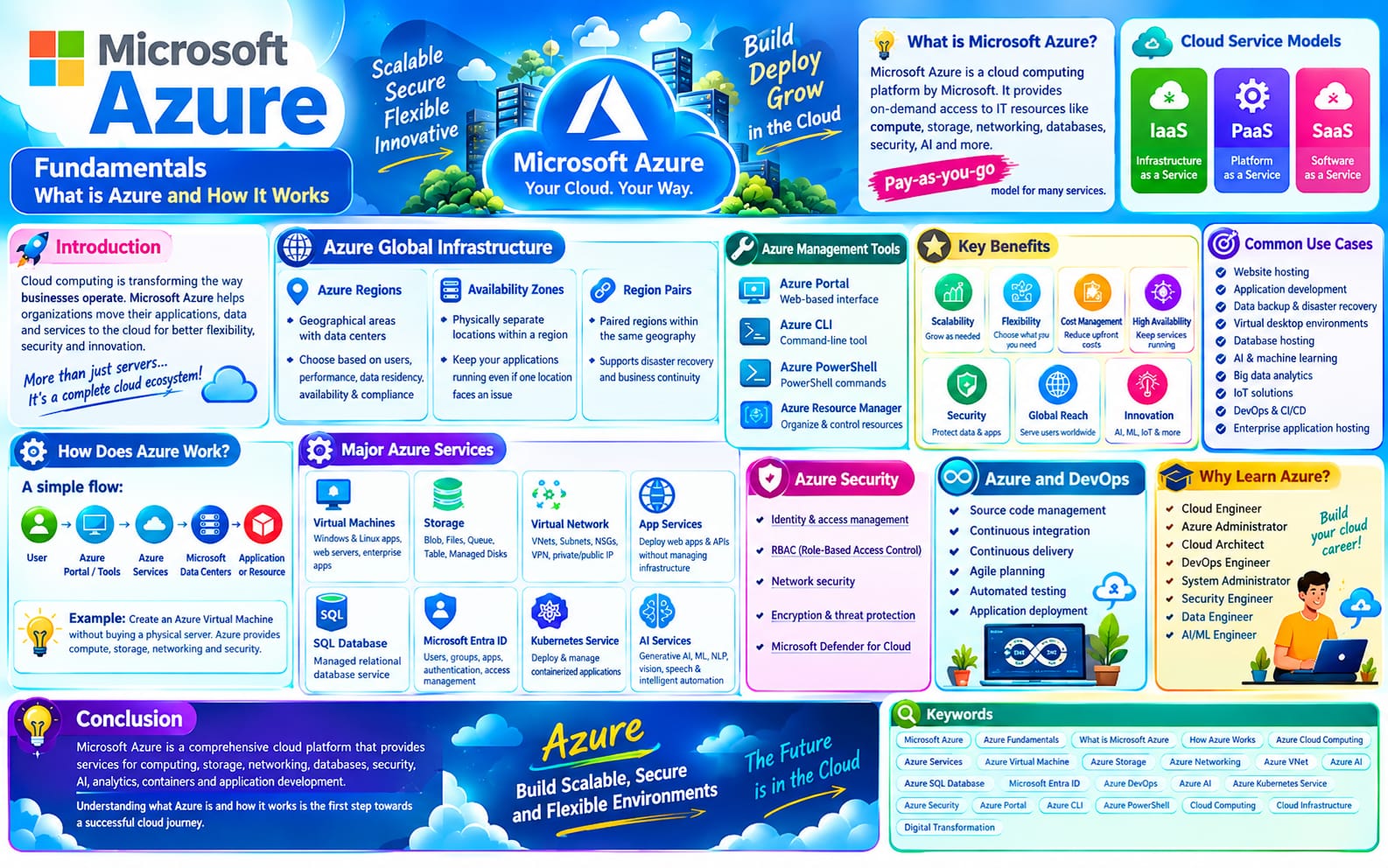
Microsoft Azure is a cloud platform that provides a wide
range of services to help individuals and organizations build and manage
applications through Microsoft’s global data centers.
Azure supports:
- Application
hosting
- Data
storage and processing
- Networking
and security
- Artificial
intelligence and analytics
Instead of managing physical servers, users rely on Azure’s
infrastructure, allowing them to focus more on innovation and less on
maintenance.
Azure Fundamentals: The Core Building Blocks
Azure Fundamentals focuses on three main areas:
- Cloud
concepts
- Core
Azure services
- Security,
pricing, and support
These areas form the foundation for understanding how Azure
works.
Cloud Service Models in Azure
Azure offers different service models based on how much
responsibility the user wants.
Infrastructure as a Service (IaaS)
This model provides basic computing resources such as
virtual machines, storage, and networking. Users control operating systems and
applications, while Azure manages the physical infrastructure.
IaaS is useful for organizations that want flexibility and
control without owning hardware.
Platform as a Service (PaaS)
In this model, Azure manages infrastructure, operating
systems, and runtime environments. Users focus only on building and deploying
applications.
PaaS helps reduce development time and operational
complexity.
Software as a Service (SaaS)
SaaS delivers complete software solutions over the internet.
Users simply access the software through a browser without worrying about
installation or maintenance.
This model is widely used for productivity and business
applications.
Azure Global Infrastructure
Azure operates one of the largest cloud infrastructures in
the world. Its data centers are organized into:
- Regions
(geographical areas)
- Availability
Zones (physically separate locations within a region)
This design ensures:
- High
availability
- Fault
tolerance
- Disaster
recovery
- Faster
access for global users
Global infrastructure is one of Azure’s biggest strengths.
Core Azure Services Explained
Compute Services
Compute services allow applications to run in the cloud.
Azure provides flexible computing options that support different workloads,
from small applications to enterprise systems.
These services remove the need to manage physical servers
and provide scalability on demand.
Storage Services
Azure storage services handle different types of data,
including files, databases, and large unstructured data.
Azure storage is designed to be:
- Highly
durable
- Secure
- Scalable
- Cost-effective
Data can be accessed quickly and safely from anywhere.
Networking Services
Networking connects all Azure resources and users. Azure
provides secure and efficient networking capabilities to ensure smooth
communication between systems.
These services help control traffic, improve performance,
and protect applications from threats.
Security and Compliance in Azure
Security is a shared responsibility between Azure and the
customer. Microsoft secures the underlying cloud infrastructure, while users
manage access, configurations, and data usage.
Azure offers:
- Identity
and access management
- Threat
detection and monitoring
- Data
encryption
- Compliance
with international standards
This makes Azure suitable for industries with strict
security requirements.
Azure Pricing and Cost Management
Azure follows a pay-as-you-go model. Users are
charged based on usage rather than fixed costs.
Benefits include:
- No
upfront hardware investment
- Flexible
spending
- Cost
control tools
- Free
services for beginners
This pricing approach makes Azure accessible to learners and
startups as well as large enterprises.
Introduction to Artificial Intelligence in Azure
Artificial intelligence enables systems to learn from data,
recognize patterns, and make intelligent decisions. Azure integrates AI
directly into its cloud ecosystem, making AI more accessible and practical.
Through Azure AI, users can add intelligence to
applications without deep expertise in data science or machine learning.
Azure AI Capabilities
Azure AI offers ready-to-use services that handle common AI
tasks such as:
- Language
understanding
- Image
and video analysis
- Speech
recognition
- Decision
support
These services are designed to be easy to use, scalable, and
enterprise-ready.
Machine Learning on Azure
Azure supports the complete machine learning lifecycle:
- Data
preparation
- Model
training
- Model
evaluation
- Deployment
and monitoring
Cloud-based machine learning allows models to be trained
faster and deployed at scale without powerful local machines.
This enables organizations to transform data into actionable
insights.
Responsible AI in Azure
Microsoft emphasizes responsible AI development. Azure
follows principles that ensure AI systems are:
- Fair
and inclusive
- Reliable
and safe
- Transparent
- Secure
and privacy-focused
Azure provides tools to monitor models, reduce bias, and
ensure ethical use of AI.
How Azure Fundamentals and AI Work Together
Azure fundamentals provide the infrastructure foundation,
while AI adds intelligence on top of it.
Together, they enable:
- Smart
cloud applications
- Automation
of complex processes
- Data-driven
decision making
- Intelligent
user experiences
Cloud handles scalability and reliability, while AI brings
insights and automation.
Who Should Learn Azure Fundamentals with AI?
This learning path is ideal for:
- Students
and fresh graduates
- IT
beginners
- Developers
and testers
- Cloud
and DevOps aspirants
- Professionals
planning career transitions
It builds a strong base for advanced cloud and AI roles.
Career Advantages of Azure and AI Knowledge
Skills in Azure and AI are highly valued in today’s job
market. Organizations look for professionals who understand both cloud
infrastructure and intelligent systems.
Learning Azure Fundamentals with AI can lead to roles such
as:
- Cloud
engineer
- AI
associate
- DevOps
professional
- Solutions
architect (entry level)
It also prepares learners for Azure certifications and
advanced technologies.
Getting Started the Right Way
Beginners should focus on:
- Understanding
cloud concepts clearly
- Learning
core Azure services
- Exploring
basic AI ideas
- Practicing
with free Azure tools
Step-by-step learning ensures strong fundamentals and
long-term success.
Final Thoughts
Azure Fundamentals with AI offers a powerful starting point
for anyone entering the world of modern technology. Azure simplifies cloud
computing, while AI adds intelligence to applications, creating smarter and
more efficient systems.
By mastering these fundamentals, learners position
themselves for future-ready careers in cloud computing and artificial
intelligence. Whether you are a student, fresher, or professional, Azure and AI
together provide a strong foundation for growth in the digital era.