




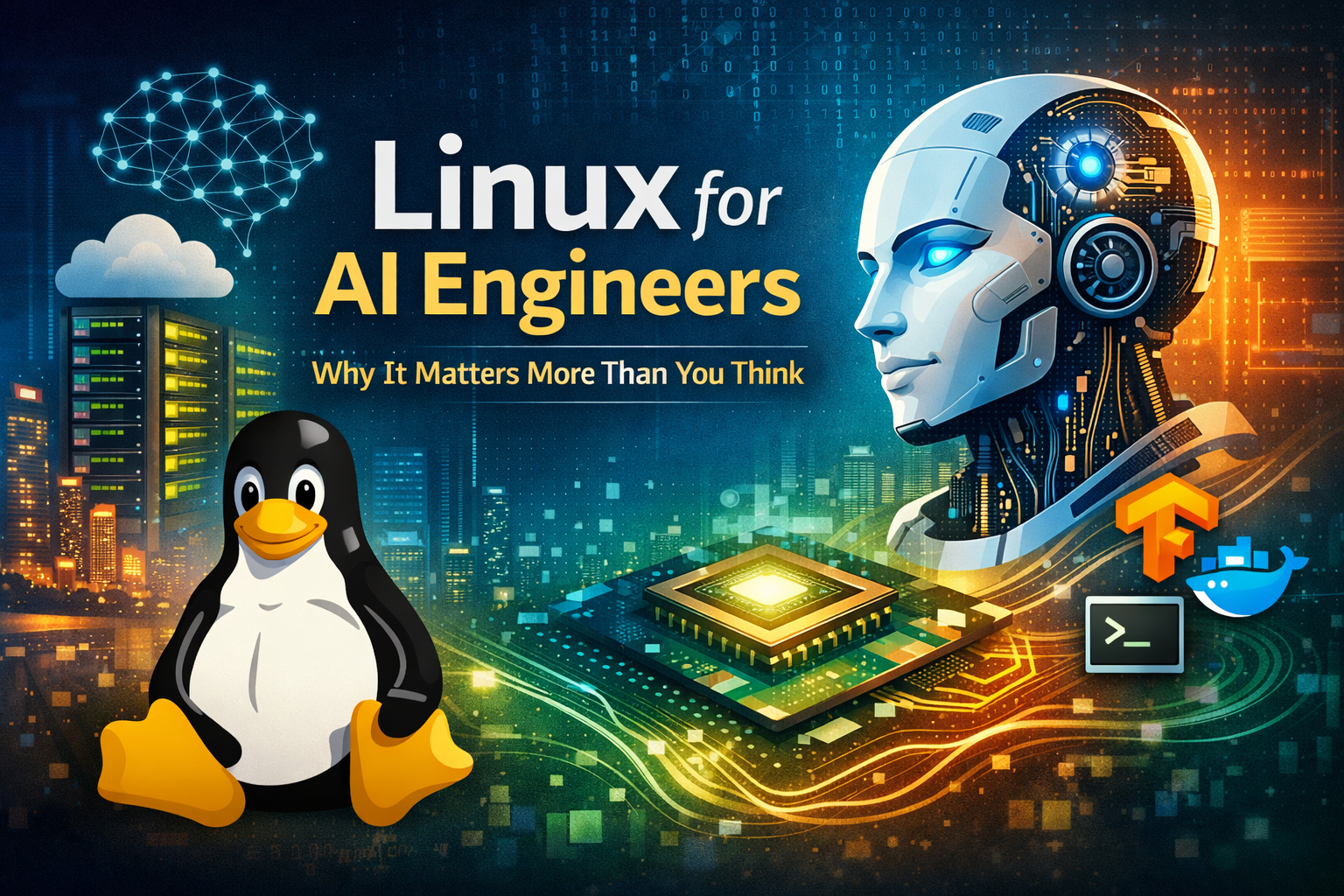
Artificial Intelligence is no longer a futuristic concept—it’s shaping industries, automating workflows, and redefining how businesses operate. From chatbots to self-driving cars, AI is everywhere. But behind the scenes of every powerful AI system lies an often-overlooked foundation: Linux.
If you're an aspiring AI engineer or already working in the
field, understanding Linux is not just an advantage—it’s practically essential.
Many beginners focus only on Python, machine learning models, and tools, but
ignore the operating system that powers everything.
In this blog, we’ll break down why Linux matters so much for
AI engineers, how it gives you an edge, and what you should learn to get
started.
1. The Backbone of AI Infrastructure
Most AI systems are not built and run on personal
laptops—they are deployed on powerful servers and cloud platforms. These
systems almost always run on Linux.
Why?
Because Linux is:
- Stable
- Scalable
- Open-source
- Highly
customizable
From startups to tech giants, Linux is the default choice
for servers. If you’re training machine learning models, working with datasets,
or deploying applications, chances are you're interacting with a Linux
environment.
Even cloud platforms like AWS, Azure, and Google Cloud
primarily use Linux-based systems. So, if you're serious about AI, Linux is
unavoidable.
2. Better Performance for AI Workloads
AI workloads require high performance—especially when
dealing with:
- Large
datasets
- GPU
processing
- Distributed
systems
Linux is optimized for performance and handles system
resources more efficiently than other operating systems.
For example:
- Better
memory management
- Faster
processing
- Efficient
handling of multiple tasks
This becomes critical when training deep learning models,
where performance can directly impact training time.
3. Native Support for AI Tools and Libraries
Most AI frameworks are designed with Linux in mind.
Popular tools like:
- TensorFlow
- PyTorch
- Keras
- Scikit-learn
work seamlessly on Linux.
In fact, many tools release updates and features for Linux
first. Some features may even work better or exclusively on Linux systems.
Also, GPU drivers (especially for NVIDIA CUDA) are more
stable and easier to configure on Linux.
4. Command Line = Superpower
One of the biggest differences between Linux and other
operating systems is the command line interface (CLI).
While beginners may find it intimidating, it becomes a
superpower once you master it.
With CLI, you can:
- Automate
repetitive tasks
- Manage
files quickly
- Run
scripts efficiently
- Control
servers remotely
Example:
Instead of manually clicking through folders, you can process thousands of
files using a single command.
For AI engineers working with massive datasets, this saves
hours of time.
5. Essential for Working with Servers
AI engineers rarely work only on local machines. Most
real-world AI projects involve:
- Remote
servers
- Cloud
environments
- Virtual
machines
These systems are typically accessed via SSH and run Linux.
So, you need to know:
- How
to connect to servers
- How
to navigate directories
- How
to install packages
- How
to run scripts remotely
Without Linux knowledge, managing AI projects in production
becomes very difficult.
6. Open Source Ecosystem
Linux is open-source, and so is most of the AI ecosystem.
This creates a powerful environment where:
- Developers
collaborate globally
- Tools
improve rapidly
- You
can customize everything
As an AI engineer, you’ll often use open-source tools,
contribute to projects, or modify existing solutions.
Linux gives you full control over your system, unlike closed
environments.
7. Automation and Scripting
AI engineers frequently deal with repetitive tasks like:
- Data
preprocessing
- Model
training
- Log
monitoring
Linux allows you to automate these using:
- Bash
scripting
- Cron
jobs
- Shell
commands
For example:
You can schedule a model training job to run automatically every night.
This level of automation increases productivity and
efficiency.
8. Containerization and DevOps
Modern AI development is closely tied to DevOps practices.
Tools like:
- Docker
- Kubernetes
are widely used to deploy AI applications.
These tools are built for Linux environments.
As an AI engineer, you’ll need to:
- Package
applications into containers
- Deploy
models in production
- Scale
applications
Linux is the foundation for all of this.
9. Security and Stability
AI systems often handle sensitive data. Security becomes
critical.
Linux offers:
- Strong
permission control
- Secure
architecture
- Frequent
updates
It is less vulnerable to common threats compared to other
operating systems.
Also, Linux systems are known for their stability. They can
run for months without crashing, making them ideal for production environments.
10. Cost-Effective Solution
Linux is free and open-source.
For companies working with large-scale AI systems, this
reduces costs significantly.
Instead of paying for licenses, organizations invest in:
- Hardware
- Cloud
resources
- Development
As an AI engineer, working with Linux also makes you more
valuable in cost-conscious environments.
11. Real-World Industry Usage
Let’s look at where Linux is used in AI:
- Data
centers
- Cloud
platforms
- Research
labs
- Startups
and tech companies
Even companies working on:
- Self-driving
cars
- Natural
language processing
- Recommendation
systems
rely heavily on Linux-based systems.
So, if you want to work in real-world AI projects, Linux
knowledge is non-negotiable.
12. Learning Linux is Easier Than You Think
Many beginners avoid Linux because they think it’s
complicated.
But the truth is:
You don’t need to learn everything.
Start with basics:
- File
navigation (ls, cd, pwd)
- File
operations (cp, mv, rm)
- Package
installation
- Basic
shell commands
Gradually, you can move to:
- Shell
scripting
- Process
management
- Networking
basics
With regular practice, Linux becomes second nature.
13. Boosts Your Career Opportunities
Companies look for engineers who can:
- Build
models
- Deploy
them
- Manage
systems
If you only know AI theory but not Linux, you are limiting
your opportunities.
But if you combine:
- AI
skills
- Linux
knowledge
- Cloud
basics
you become a complete AI engineer.
This significantly increases your chances of getting hired
and growing in your career.
14. Linux + AI = Future-Proof Skillset
The future of AI is:
- Cloud-based
- Scalable
- Automated
And Linux is at the center of all of it.
Whether it's:
- MLOps
- Data
engineering
- AI
deployment
Linux knowledge will always be relevant.
15. Practical Use Case Example
Imagine you are building a machine learning model.
Here’s where Linux comes in:
- You
connect to a cloud server (Linux-based)
- Upload
your dataset
- Install
Python and libraries
- Train
your model using GPU
- Monitor
logs via terminal
- Deploy
the model using Docker
Every step involves Linux.
Without it, the process becomes much harder
Conclusion
Linux is not just another skill—it’s a core foundation
for AI engineers.
While tools and technologies may change, Linux remains
constant in the AI ecosystem.
If you truly want to succeed in AI, don’t ignore Linux.
Start small, practice daily, and gradually build your
expertise.
Because at the end of the day, the smartest AI models still
need a strong system to run on—and that system is Linux.