




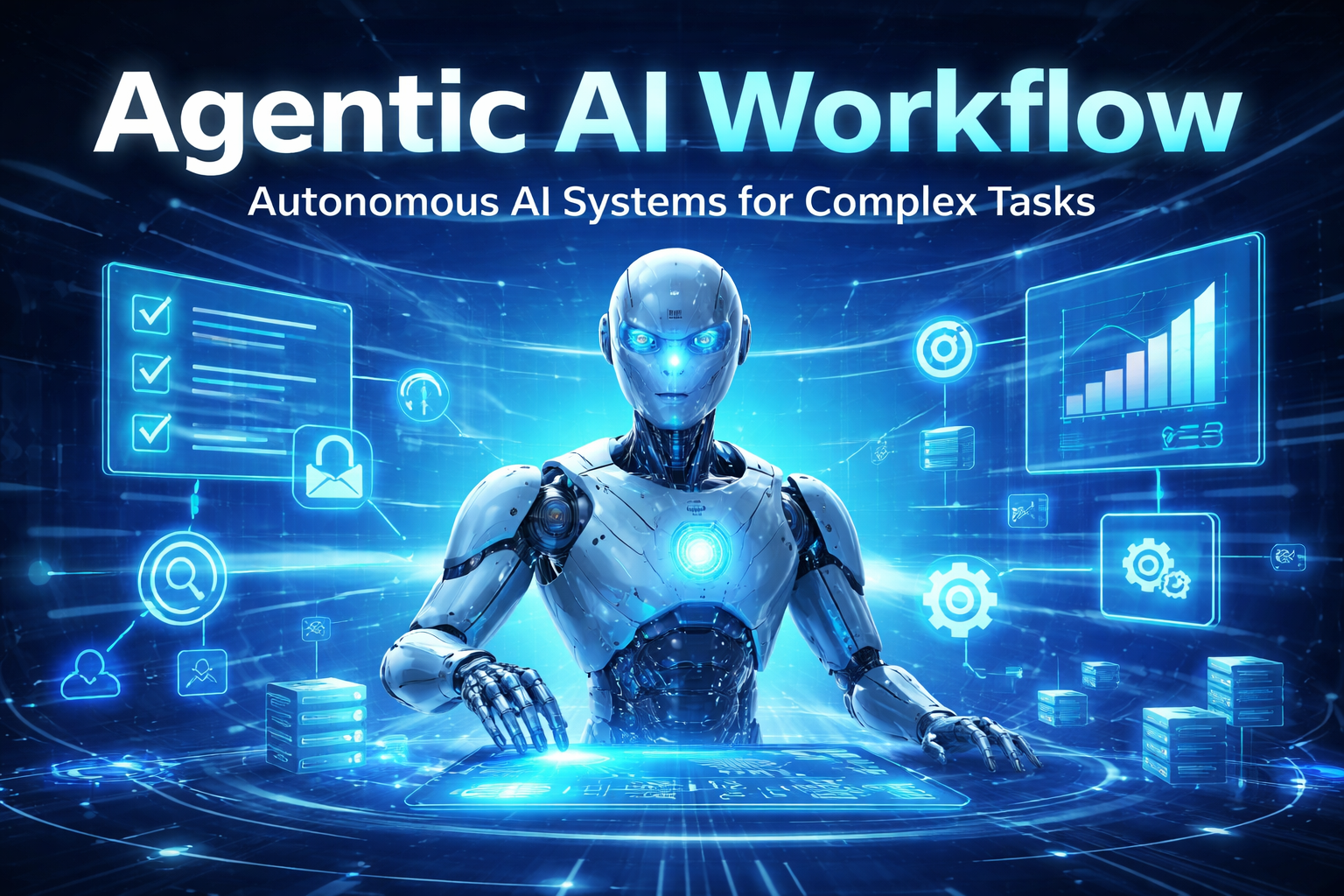
Agentic AI Workflow: How Autonomous AI Systems Plan,
Think, and Execute Tasks
Artificial Intelligence is evolving rapidly. Traditional AI
systems could answer questions, generate text, or analyze data when prompted by
users. However, a new generation of AI systems called Agentic AI is
transforming how machines operate.
Agentic AI systems are designed to behave like autonomous
digital agents that can plan tasks, make decisions, use tools, and execute
complex workflows with minimal human intervention.
Instead of simply responding to prompts, Agentic AI can understand
a goal, break it into tasks, use external tools, evaluate results, and improve
its output.
This blog explores the Agentic AI workflow, its
architecture, components, real-world applications, and why it is becoming the
foundation of next-generation intelligent systems.
What is Agentic AI?
Agentic AI refers to AI systems that operate as
intelligent agents capable of making decisions and performing multi-step tasks
autonomously.
Unlike traditional AI systems that produce a single response
to a prompt, Agentic AI works through structured workflows to complete a
goal.
For example:
Traditional AI task
User: Write a blog about AI.
Agentic AI task
User: Research AI trends, collect data, analyze insights, and generate a
complete blog article.
Agentic AI systems rely on orchestration frameworks such as:
- LangChain
- AutoGPT
- CrewAI
- Microsoft
Semantic Kernel
These frameworks allow developers to build AI agents
capable of reasoning, planning, and interacting with tools.
Why Agentic AI is Important
Modern organizations require AI systems that can handle complex
workflows rather than isolated tasks.
Agentic AI provides several advantages:
Automation of multi-step processes
AI can plan and execute tasks without constant human
guidance.
Improved decision-making
Agents analyze information before choosing the best action.
Tool integration
Agents can interact with APIs, databases, and software
systems.
Scalable intelligence
Multiple AI agents can collaborate to solve complex
problems.
Because of these capabilities, Agentic AI is becoming
essential for business automation, research systems, software development,
and intelligent assistants.
Core Components of an Agentic AI Workflow
An Agentic AI system operates through a structured workflow
that includes several critical components.
1. Goal Definition
Every Agentic AI workflow begins with a clear objective.
The user provides a goal, and the AI agent interprets the
task.
Example goals:
- Generate
a market research report
- Analyze
customer data
- Build
a software application
- Create
marketing content
The AI system first analyzes the intent and scope of the
request.
2. Task Planning
Once the goal is understood, the AI agent breaks it down
into smaller tasks.
For example, if the goal is to create a blog post about AI
trends, the workflow may look like this:
- Search
for recent AI news
- Identify
key developments
- Create
a content outline
- Generate
article sections
- Optimize
the content for SEO
Planning is typically handled using large language models
such as:
- GPT-4
- Claude
- Gemini
These models help agents reason about tasks and determine
the best sequence of actions.
Memory Systems in Agentic AI
For agents to operate effectively, they must maintain
memory.
Memory allows agents to store knowledge, track progress,
and recall previous interactions.
Agentic AI systems typically include two types of memory.
Short-Term Memory
Short-term memory stores the current task context.
Examples include:
- User
instructions
- Intermediate
outputs
- Conversation
history
This allows the AI to maintain continuity during execution.
Long-Term Memory
Long-term memory stores information that may be useful for
future tasks.
Examples include:
- Knowledge
bases
- research
findings
- stored
documents
Vector databases commonly used for long-term memory include:
- Pinecone
- Weaviate
- Chroma
These databases allow AI systems to perform semantic
search and retrieval.
Tool Usage in Agentic AI Systems
One of the most powerful features of Agentic AI is the
ability to use external tools.
Traditional AI models rely only on training data. Agentic AI
agents can interact with real systems and perform actions.
Common tools used by AI agents include:
Web search engines
APIs
Databases
Code interpreters
Data processing tools
Examples include:
- Google
Search API
- Python
- Docker
This allows AI agents to perform tasks such as:
- collecting
data
- running
scripts
- analyzing
datasets
- generating
reports
Reasoning and Decision-Making
Agentic AI systems must decide what action to take next.
To accomplish this, they use reasoning frameworks such as:
ReAct (Reason + Act)
Chain-of-Thought reasoning
Tree-of-Thought reasoning
These methods allow the AI agent to think step-by-step
before executing an action.
A typical reasoning loop looks like this:
- Understand
the goal
- Decide
the next action
- Use
a tool or retrieve data
- Analyze
the result
- Continue
until the task is complete
This process is often called the Agent Execution Loop.
Single-Agent vs Multi-Agent Workflows
Agentic AI systems can operate using either single agents
or multiple collaborative agents.
Single Agent Systems
In a single-agent workflow, one AI agent performs all tasks.
Example:
Research → Data analysis → Content generation.
Single-agent systems are simpler but may struggle with
complex tasks.
Multi-Agent Systems
Multi-agent workflows involve multiple specialized agents
working together.
Example AI team:
Research Agent
Data Analyst Agent
Content Writer Agent
Quality Reviewer Agent
Frameworks like:
- CrewAI
enable developers to build collaborative AI systems where
each agent has a specific role.
Real-World Applications of Agentic AI
Agentic AI is already being used across many industries.
Software Development
AI agents can assist developers by:
- writing
code
- debugging
errors
- testing
applications
- deploying
systems
Tools like:
- GitHub
Copilot
are moving toward fully autonomous development workflows.
Customer Support Automation
AI agents can manage customer service operations by:
- answering
questions
- retrieving
account information
- resolving
common issues
This significantly reduces response times.
Research and Data Analysis
Research agents can:
- analyze
thousands of documents
- extract
key insights
- generate
structured reports
This helps organizations process large volumes of
information quickly.
Business Process Automation
Agentic AI can automate tasks such as:
- invoice
processing
- HR
onboarding
- financial
analysis
- marketing
campaign optimization
This reduces operational costs and increases efficiency.
Challenges of Agentic AI
Although Agentic AI offers powerful capabilities, it also
presents several challenges.
Reliability
AI agents may sometimes produce inaccurate outputs.
Tool dependency
External APIs and services may fail.
Security risks
Agents interacting with enterprise systems require strong
security controls.
Infrastructure cost
Large AI models require significant computing resources.
Cloud platforms commonly used for AI deployments include:
- Amazon
Web Services
- Microsoft
Azure
- Google
Cloud
These platforms provide scalable infrastructure for AI
applications.
The Future of Agentic AI
Agentic AI represents a major shift from passive AI systems
to autonomous intelligent workers.
Future developments may include:
Autonomous research assistants
AI project managers
Self-improving software systems
Fully automated digital workforces
As organizations continue investing in AI technologies,
Agentic AI will become a core component of modern enterprise systems.
Conclusion
Agentic AI is transforming the way artificial intelligence
operates. Instead of generating isolated responses, AI agents can plan,
reason, execute tasks, and collaborate with other agents to achieve complex
goals.
A typical Agentic AI workflow includes:
Goal definition
Task planning
Memory management
Tool usage
Reasoning and execution
Evaluation and improvement
With frameworks such as LangChain, CrewAI, and
AutoGPT, developers are building the next generation of intelligent
systems.
Agentic AI is not just an upgrade to existing AI
technologies—it represents the future of autonomous digital intelligence.