




Introduction
Over the past decade, cloud computing has fundamentally
transformed how organizations build, deploy, and manage digital infrastructure.
Companies no longer need to maintain expensive physical data centers; instead,
they can rely on cloud platforms that provide scalable computing power,
storage, networking, and advanced services on demand.
Initially, most organizations adopted a single-cloud
strategy, choosing one provider to host their workloads. However, as cloud
adoption matured, businesses began to face limitations such as vendor lock-in,
performance constraints, and dependency risks. To overcome these challenges,
many enterprises are now implementing multi-cloud strategies.
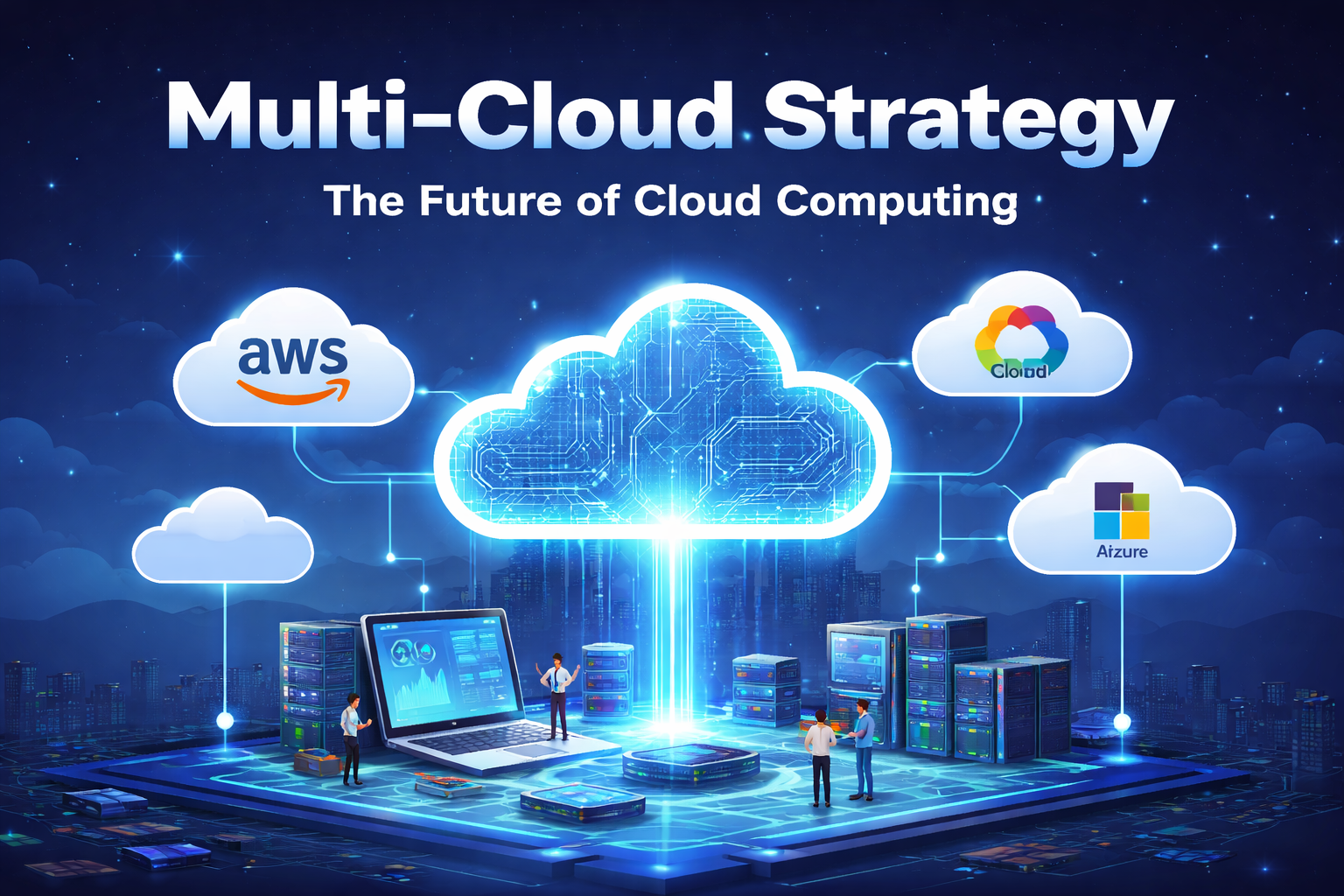
A multi-cloud architecture involves using multiple
cloud providers simultaneously to host applications, store data, and run
workloads. Rather than relying on one provider, organizations distribute their
infrastructure across platforms like Amazon Web Services, Microsoft
Azure, and Google Cloud Platform.
This approach enables businesses to take advantage of each
provider’s strengths while improving reliability, performance, and flexibility.
As digital transformation accelerates across industries, multi-cloud
environments are becoming a core component of modern IT architecture.
This guide explores the concept, architecture, benefits,
challenges, implementation strategies, and future of multi-cloud computing
in detail.
Understanding Multi-Cloud Architecture
Multi-cloud refers to the use of two or more cloud
computing services from different providers within a single infrastructure
ecosystem.
Organizations typically combine services from several cloud
platforms to support different workloads. Each provider offers unique
capabilities, pricing models, and geographic infrastructure.
For example:
A technology company might use:
- Amazon
Web Services for scalable compute resources and object storage
- Google
Cloud Platform for machine learning and advanced analytics
- Microsoft
Azure for enterprise application integration
By distributing workloads across multiple providers,
organizations create a flexible and resilient infrastructure that
reduces dependency on any single vendor.
Multi-cloud architectures are widely used by:
- Large
enterprises
- SaaS
platforms
- Fintech
companies
- Media
streaming platforms
- Global
e-commerce businesses
These organizations require high availability, global
performance, and scalable infrastructure, which multi-cloud environments
provide.
Multi-Cloud vs Hybrid Cloud
Although the terms are often used interchangeably, multi-cloud
and hybrid cloud architectures are different concepts.
Multi-Cloud
Multi-cloud environments use multiple public cloud
providers simultaneously.
Example architecture:
- AWS
for computing
- Azure
for enterprise workloads
- Google
Cloud for AI and analytics
The goal is to distribute workloads across several providers
to maximize performance and flexibility.
Hybrid Cloud
Hybrid cloud combines public cloud infrastructure with
private infrastructure, such as on-premise data centers.
Example:
- On-premise
servers for sensitive data
- Public
cloud services for scalable workloads
Hybrid cloud is often used when organizations must meet
strict regulatory or security requirements.
Why Enterprises Are Adopting Multi-Cloud
Modern enterprises adopt multi-cloud strategies for several
strategic and operational reasons.
1 Vendor Lock-In Avoidance
Vendor lock-in occurs when organizations become heavily
dependent on a single cloud provider’s services, APIs, and infrastructure.
Migrating applications away from that provider can become
expensive and technically complex.
By adopting multiple providers such as Amazon Web
Services and Microsoft Azure, companies maintain greater control
over their infrastructure and retain the flexibility to migrate workloads when
necessary.
2 High Availability and Fault Tolerance
Even large cloud providers occasionally experience outages.
If an organization relies entirely on one cloud platform,
such outages can disrupt business operations.
Multi-cloud architectures allow companies to deploy
workloads across multiple platforms. If one provider experiences downtime,
traffic can be redirected to another provider automatically.
This design significantly improves system reliability and
uptime.
3 Best-of-Breed Cloud Services
Each cloud provider specializes in certain technologies.
For example:
Amazon Web Services
Strengths include:
- Massive
infrastructure scalability
- Serverless
computing
- Advanced
storage services
Google Cloud Platform
Known for:
- Machine
learning and AI platforms
- Big
data analytics
- Data
processing frameworks
Microsoft Azure
Excels in:
- Enterprise
software integration
- Hybrid
cloud solutions
- Microsoft
ecosystem compatibility
A multi-cloud strategy allows organizations to use the best
service from each provider.
4 Cost Optimization
Cloud providers have different pricing models.
Some providers offer lower storage costs, while others offer
cheaper compute resources or better pricing for data analytics.
Organizations can strategically place workloads on the most
cost-effective platform to optimize their cloud spending.
5 Geographic Performance Optimization
Large enterprises serve users across multiple continents.
Different cloud providers have data centers in different
geographic regions.
Using multiple providers allows companies to deploy
applications closer to users worldwide, improving latency and performance.
Multi-Cloud Architecture Components
Implementing a multi-cloud environment requires several key
architectural components.
Cloud Platforms
The foundation of any multi-cloud architecture is the cloud
providers themselves.
Common providers include:
- Amazon
Web Services
- Microsoft
Azure
- Google
Cloud Platform
- IBM
Cloud
- Oracle
Cloud
Each provider contributes different services to the overall
architecture.
Containers and Application Portability
Applications running in multi-cloud environments must be
portable across platforms.
Containerization technologies such as Docker package
applications with their dependencies so they can run consistently across
multiple cloud environments.
Containers provide several advantages:
- Portability
- Faster
deployments
- Isolation
between applications
- Consistent
runtime environments
Container Orchestration
Large-scale container deployments require orchestration
systems.
The most widely used orchestration platform is Kubernetes.
Kubernetes manages container workloads by automatically
handling:
- Deployment
- Scaling
- Load
balancing
- Self-healing
- Traffic
routing
Because Kubernetes is cloud-agnostic, it plays a crucial
role in enabling multi-cloud deployments.
Infrastructure as Code
Managing cloud resources manually becomes impractical in
multi-cloud environments.
Infrastructure-as-Code tools such as Terraform allow
engineers to define cloud infrastructure using code.
These tools enable automated provisioning of resources
across multiple cloud platforms.
Benefits include:
- Faster
infrastructure deployment
- Reduced
configuration errors
- Version-controlled
infrastructure
Multi-Cloud Use Cases
Disaster Recovery
Disaster recovery is one of the most common use cases for
multi-cloud architectures.
Organizations replicate critical applications across
multiple cloud providers.
If one provider experiences a failure, backup systems on
another provider can immediately take over.
Global Application Deployment
Companies serving global customers deploy their applications
across multiple cloud regions and providers.
Example deployment strategy:
- North
America → AWS
- Europe
→ Azure
- Asia
→ Google Cloud
This architecture improves performance by reducing latency.
Artificial Intelligence and Big Data
Many organizations run machine learning workloads on Google
Cloud Platform, which provides powerful AI tools.
Meanwhile, they store and process large datasets on Amazon
Web Services.
This allows them to combine powerful infrastructure with
advanced analytics capabilities.
SaaS Platforms
Software-as-a-Service companies frequently deploy
applications across multiple cloud providers.
This ensures high availability and allows them to scale
infrastructure as their user base grows.
Challenges of Multi-Cloud
Despite its advantages, multi-cloud adoption introduces
several challenges.
Operational Complexity
Managing multiple cloud providers requires specialized
expertise.
Each provider has unique:
- APIs
- configuration
tools
- security
policies
- management
interfaces
Organizations must invest in skilled cloud engineers to
manage these environments.
Security Management
Maintaining consistent security policies across multiple
cloud platforms can be difficult.
Organizations must implement centralized identity management
and access control systems.
Security tools must also monitor workloads across all cloud
providers.
Monitoring and Observability
Monitoring distributed systems across multiple clouds
requires advanced observability platforms.
Tools such as:
- Datadog
- Prometheus
help organizations track system performance and detect
issues across cloud environments.
Data Transfer Costs
Moving large amounts of data between cloud providers can
generate significant network charges.
Architects must design data pipelines carefully to minimize
cross-cloud transfers.
Best Practices for Implementing Multi-Cloud
Organizations adopting multi-cloud strategies should follow
several best practices.
Build Cloud-Agnostic Applications
Applications should be designed to run on any cloud platform
without modification.
Using containers and microservices architecture makes
applications more portable.
Automate Infrastructure Deployment
Infrastructure automation tools like Terraform enable
consistent deployment across multiple cloud providers.
Automation reduces operational overhead and improves
reliability.
Implement Centralized Security Policies
Organizations should implement centralized identity and
access management systems.
This ensures consistent security controls across all cloud
environments.
Optimize Cost Management
Cloud cost monitoring tools help organizations track
spending across providers.
Regular cost optimization prevents unnecessary expenses.
Future of Multi-Cloud Computing
The future of cloud computing is increasingly multi-cloud
and distributed.
Several emerging technologies are accelerating this trend:
Artificial Intelligence
Edge Computing
Internet of Things
Cloud-native architectures
Platforms like Kubernetes are making it easier for
developers to build applications that run across multiple cloud providers.
Industry analysts predict that most enterprises will
adopt multi-cloud strategies within the next decade as organizations seek
greater flexibility and resilience.
Multi-cloud environments will also become increasingly
integrated with AI-driven automation, enabling self-optimizing cloud
infrastructure.
Conclusion
Multi-cloud strategies have become a cornerstone of modern
cloud architecture.
By leveraging multiple cloud providers such as Amazon Web
Services, Microsoft Azure, and Google Cloud Platform,
organizations can achieve greater reliability, scalability, and flexibility.
Although managing multiple cloud environments introduces
complexity, modern tools such as Kubernetes, Docker, and Terraform
make it possible to build portable, scalable cloud architectures.
As businesses continue to accelerate their digital
transformation initiatives, multi-cloud will play an increasingly critical role
in enabling innovation and global scalability.
Organizations that successfully implement multi-cloud
strategies will gain a significant competitive advantage in the digital
economy.