




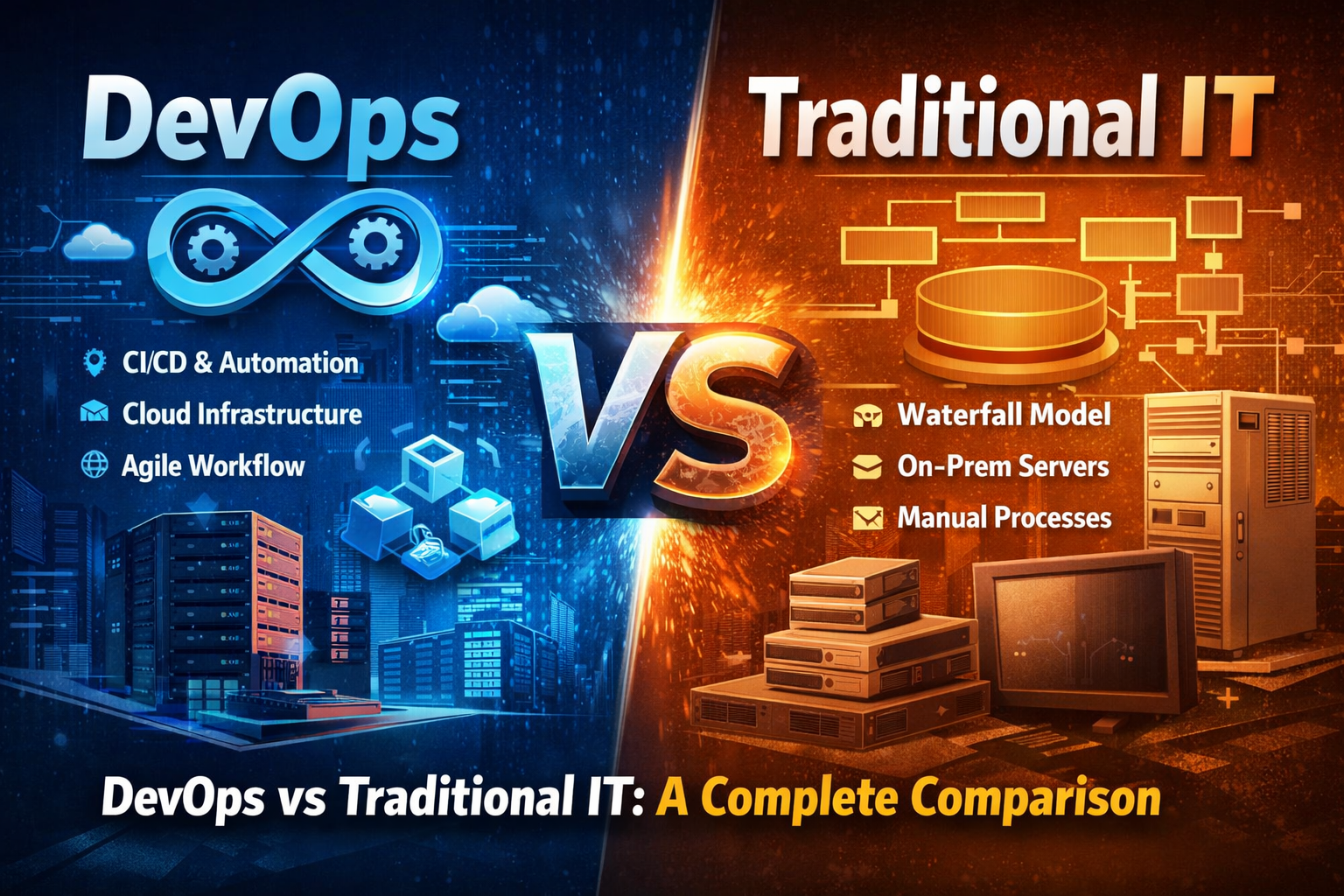
For decades, Traditional IT was the backbone of
software development and infrastructure management. It helped organizations
build stable systems and control operations.
But as businesses demanded speed, scalability, and
continuous innovation, Traditional IT started showing its limits. This led
to the rise of DevOps — a modern approach that transformed how software
is built, tested, deployed, and maintained.
This blog explains the key differences between
Traditional IT and DevOps, focusing on technology, processes, and business
impact.
1. Development Approach
Traditional IT
Traditional IT follows a Waterfall model, where
development happens in fixed stages:
- Requirement
gathering
- Design
- Development
- Testing
- Deployment
Each phase starts only after the previous one ends.
Limitations:
- Long
development cycles
- Late
discovery of bugs
- Difficult
to handle changing requirements
DevOps
DevOps follows Agile and iterative development:
- Small,
frequent changes
- Continuous
feedback
- Rapid
improvement cycles
Advantage:
DevOps allows faster innovation and better adaptability to business needs.
2. Team Structure and Collaboration
Traditional IT
- Separate
teams for Development, Testing, and Operations
- Limited
communication between teams
- Siloed
responsibilities
This often leads to the classic problem:
“It works on my machine.”
DevOps
- Cross-functional
teams
- Shared
responsibility
- Strong
collaboration
Developers and operations work together from start to
finish.
Result:
Fewer misunderstandings and smoother releases.
3. Deployment Process
Traditional IT
- Manual
deployments
- Scheduled
releases (monthly or quarterly)
- High
risk during deployment
Downtime during releases is common.
DevOps
- Automated
deployments
- Continuous
Delivery (CD)
- Minimal
or zero downtime
Impact:
DevOps enables multiple releases per day instead of per year.
4. Infrastructure Management
Traditional IT
- On-premise
servers
- Manual
provisioning
- Fixed
infrastructure capacity
Scaling requires hardware purchase and setup.
DevOps
- Cloud-based
infrastructure
- Infrastructure
as Code (IaC)
- Auto-scaling
Servers can be created or destroyed using code.
Benefit:
Faster scaling and lower operational costs.
5. Testing Strategy
Traditional IT
- Manual
testing
- Testing
happens late in the cycle
- Bug
fixing delays release
DevOps
- Automated
testing
- Testing
integrated into CI/CD pipelines
- Early
bug detection
Result:
Higher software quality with faster releases.
6. Monitoring and Feedback
Traditional IT
- Reactive
monitoring
- Issues
discovered after failure
- Manual
troubleshooting
DevOps
- Continuous
monitoring
- Real-time
alerts
- Proactive
issue resolution
Advantage:
Problems are detected and resolved before users are affected.
7. Security: Traditional IT vs DevSecOps
Traditional IT
- Security
handled at the end
- Manual
security checks
- High
risk of vulnerabilities
DevOps (DevSecOps)
- Security
integrated from the start
- Automated
security scans
- Continuous
compliance
Impact:
Security becomes a shared responsibility, not a bottleneck.
8. Speed and Time to Market
Traditional IT
- Long
release cycles
- Slow
response to market changes
DevOps
- Faster
release cycles
- Rapid
innovation
- Continuous
improvement
Business Impact:
Companies reach customers faster and stay competitive.
9. Cost Efficiency
Traditional IT
- High
infrastructure cost
- Manual
operations
- High
maintenance expenses
DevOps
- Pay-as-you-go
cloud model
- Automation
reduces manual effort
- Efficient
resource usage
Result:
Lower operational costs over time.
10. Reliability and Stability
Traditional IT
- Large
updates increase risk
- Rollback
is complex
DevOps
- Small,
frequent updates
- Easy
rollback
- High
system availability
Benefit:
DevOps improves system stability while enabling rapid change.
DevOps vs Traditional IT: Comparison Table
|
Aspect |
Traditional IT |
DevOps |
|
Development Model |
Waterfall |
Agile |
|
Deployment |
Manual |
Automated |
|
Release Frequency |
Monthly/Quarterly |
Daily/Continuous |
|
Infrastructure |
On-Premise |
Cloud |
|
Testing |
Manual |
Automated |
|
Monitoring |
Reactive |
Proactive |
|
Security |
End-stage |
Built-in |
|
Scalability |
Limited |
High |
|
Collaboration |
Siloed |
Cross-functional |
When Traditional IT Still Makes Sense
Traditional IT can still be useful when:
- Systems
require extreme stability
- Applications
rarely change
- Regulatory
constraints are strict
However, even these environments are gradually adopting
DevOps practices.
Why DevOps Is the Future of IT
DevOps is not just a toolset — it is a culture shift.
It focuses on:
- Collaboration
- Automation
- Continuous
learning
- Faster
value delivery
Organizations that adopt DevOps:
- Innovate
faster
- Reduce
failures
- Improve
customer satisfaction