



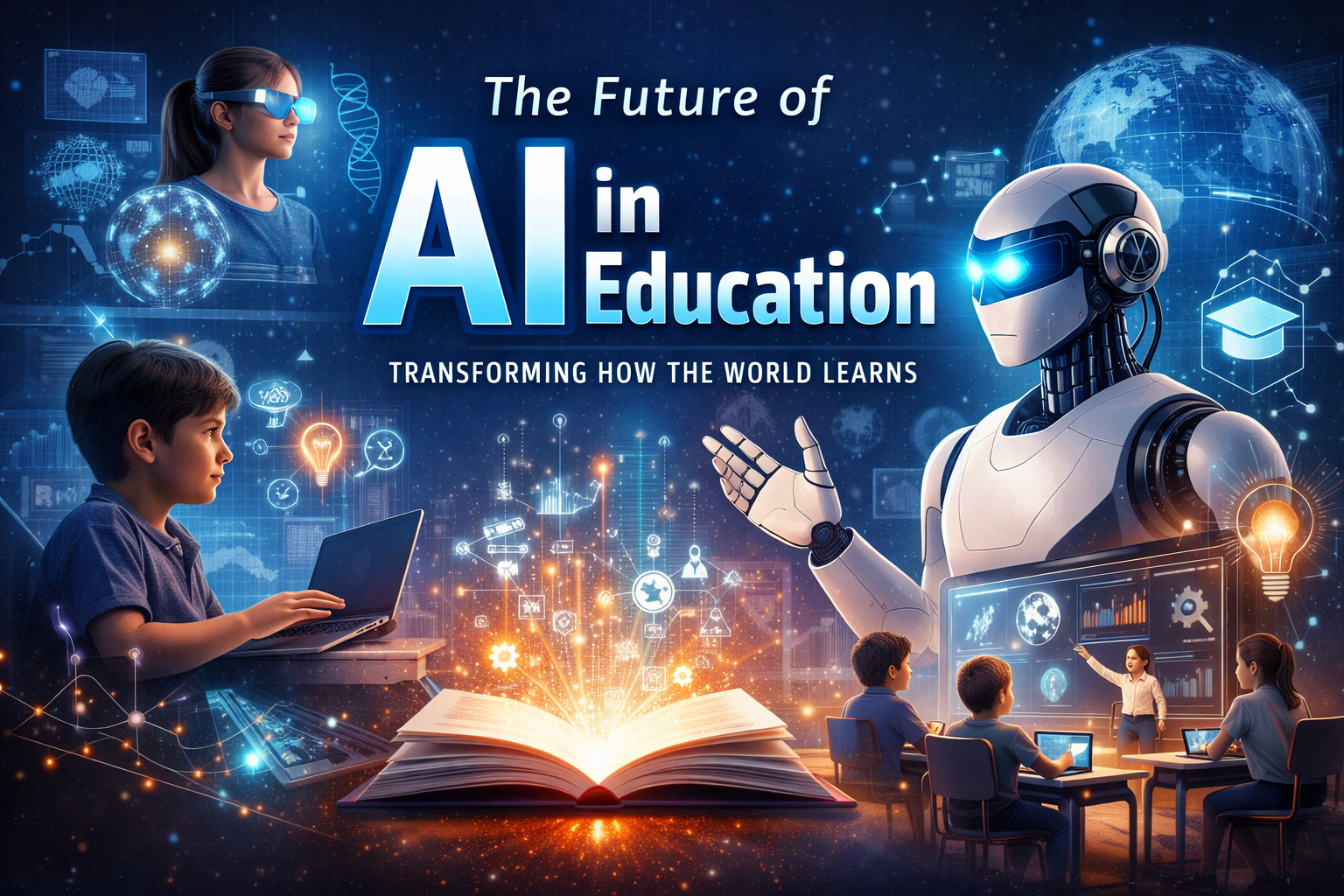
The Future of Artificial Intelligence in Education: Redefining How the World Learns
Education is at a turning point. Traditional classrooms, fixed curricula, and standardized assessments are no longer sufficient for a rapidly evolving digital world. Artificial Intelligence (AI) is emerging as the most powerful force reshaping the education sector—transforming how knowledge is delivered, consumed, assessed, and personalized.
The future of education will not be about replacing teachers with machines. Instead, it will be about augmenting human intelligence with artificial intelligence to create smarter, more inclusive, and lifelong learning ecosystems.
Understanding AI’s Role in Education
Artificial Intelligence in education refers to systems that can learn from data, adapt to student behavior, and make intelligent decisions. Technologies such as machine learning, natural language processing, and predictive analytics enable platforms to understand how students learn and respond accordingly.
Unlike traditional educational software, AI systems continuously improve—becoming more accurate and effective over time.
Why the Education Sector Needs AI
Modern education faces several challenges:
-
One-size-fits-all teaching methods
-
Overburdened teachers
-
Low student engagement
-
Skill gaps between education and industry
-
Limited access to quality education in remote areas
AI addresses these problems by introducing personalization, scalability, and intelligence into learning systems.
The Future Impact of AI on Education
1. Hyper-Personalized Learning Experiences
In the future, learning will be student-driven, not syllabus-driven.
AI-powered platforms will analyze:
-
Learning pace
-
Cognitive strengths
-
Knowledge gaps
-
Emotional engagement
Based on this data, AI will create custom learning paths for each student. Fast learners can advance quickly, while others receive additional support—without judgment or pressure.
This shift will drastically reduce dropout rates and improve academic confidence.
2. AI Tutors That Learn With Students
AI-based virtual tutors will evolve beyond simple chatbots. These systems will:
-
Understand student doubts contextually
-
Explain concepts in multiple ways
-
Adapt explanations based on comprehension level
-
Track long-term progress
Students will have access to 24/7 personalized academic assistance, making learning continuous rather than limited to classroom hours.
3. Smarter Assessments Beyond Exams
Future assessments will move away from memorization.
AI will evaluate:
-
Conceptual understanding
-
Problem-solving skills
-
Creativity and reasoning
-
Learning consistency over time
Instead of one final exam, AI will enable continuous, data-driven evaluation, offering real-time feedback to both students and teachers.
4. Intelligent Content Creation and Curriculum Design
AI will play a major role in creating and updating educational content. It will:
-
Generate interactive lessons
-
Convert textbooks into adaptive digital modules
-
Create simulations and virtual labs
-
Update curricula based on industry trends
Education will become dynamic, aligning more closely with real-world skills and job requirements.
5. Bridging the Global Education Gap
AI has the potential to democratize education globally.
With AI-powered translation, voice recognition, and accessibility tools, students from different regions, languages, and abilities will gain access to the same quality of education.
AI will enable:
-
Multilingual classrooms
-
Learning support for students with disabilities
-
Affordable education in underserved communities
6. Data-Driven Educational Institutions
Educational institutions will increasingly rely on AI for strategic decisions. AI systems will help:
-
Predict student performance and dropout risks
-
Improve faculty effectiveness
-
Optimize learning resources
-
Enhance campus and online education management
This will result in smarter institutions with better student outcomes.
The Evolving Role of Teachers
AI will not replace teachers—but it will redefine their role.
Teachers will transition from:
-
Content deliverers → Learning facilitators
-
Manual evaluators → Academic mentors
-
Administrators → Innovators
Human qualities such as empathy, ethics, creativity, and emotional intelligence will become even more valuable in an AI-powered education system.
Ethical Challenges and Responsible AI Use
The future of AI in education also brings responsibility.
Key concerns include:
-
Student data privacy and security
-
Bias in AI algorithms
-
Over-dependence on automation
-
Unequal access to technology
To address these, educational systems must implement ethical AI frameworks, transparent policies, and inclusive digital infrastructure.
Preparing Students for an AI-Driven World
AI-powered education will shift the focus from rote learning to:
-
Critical thinking
-
Creativity
-
Digital literacy
-
Problem-solving
-
Lifelong learning
Students will not just consume knowledge—they will learn how to learn, adapt, and innovate in an AI-driven economy.
The Road Ahead: Education in 2030 and Beyond
In the next decade, we can expect:
-
AI-powered smart classrooms
-
Fully adaptive online universities
-
Skill-based certifications replacing traditional degrees
-
Personalized lifelong learning assistants
-
Global access to high-quality education
Education will no longer be a phase of life—it will become a continuous, intelligent process.
Conclusion
The future of AI in the education sector is not just about technology—it is about transformation. AI has the power to make education more personalized, inclusive, and relevant to the modern world.
When implemented ethically and thoughtfully, AI will not replace human educators—it will empower them, unlock student potential, and redefine what learning truly means in the 21st century.
The future classroom is intelligent, adaptive, and human-centered—and AI is the catalyst making it possible.